From Chaos to Strategic Calm: Building a Resilient Workforce
In the current South African business landscape, "efficiency" is the primary goal. Organizations are leaner than ever, and the drive for productivity has never been higher. However, a quiet crisis is brewing beneath the surface of many high-performing firms—one that is costing the South African economy approximately R161 billion annually.
The problem isn't a lack of effort; it is a lack of Resilience.
The "Hidden Tax": South Africa’s Disengagement Crisis
To build a resilient workforce, we must first acknowledge the data defining the modern workplace. Current research from global and local institutions suggests that the "business as usual" approach is no longer sustainable:
The Disengagement Rate: According to the Gallup 2024 State of the Global Workplace Report, only 23% of employees are truly engaged. In South Africa, this leaves the vast majority of the workforce "disengaged"—present at their desks but psychologically unattached to their work.
The Stress Epidemic: South Africa consistently ranks among the most stressed nations globally. Old Mutual’s 2024 Wellbeing Pulse Check-In highlights that roughly 37% to 41% of working South Africans experience high levels of daily stress and financial strain.
The R161 Billion Leak: This is a massive economic drain. Health economists and Investec research estimate that unaddressed mental health conditions cost the country R161 billion per year due to absenteeism and "presenteeism" (being at work but unable to function).
The Resignation Risk: A 2024 survey by the South African Depression and Anxiety Group (SADAG) found that 61% of employed South Africans would quit their jobs tomorrow if they could afford it, citing toxic workplace dynamics and a lack of authentic support.
The Trap of "Manufactured Urgency"
A primary driver of this disengagement is "Manufactured Urgency"—the habit of treating every email, task, and meeting as a crisis. While this might produce a short-term burst of activity, the long-term business costs include:
Decision Fatigue: Chronic stress impairs the brain's ability to engage in strategic, complex problem-solving.
Talent Attrition: Top talent does not leave because of the workload; they leave because of the "noise" and the background dread of a panic-driven culture rather than by crisis.
Beyond the Quick Fix: An Integrated Ecosystem
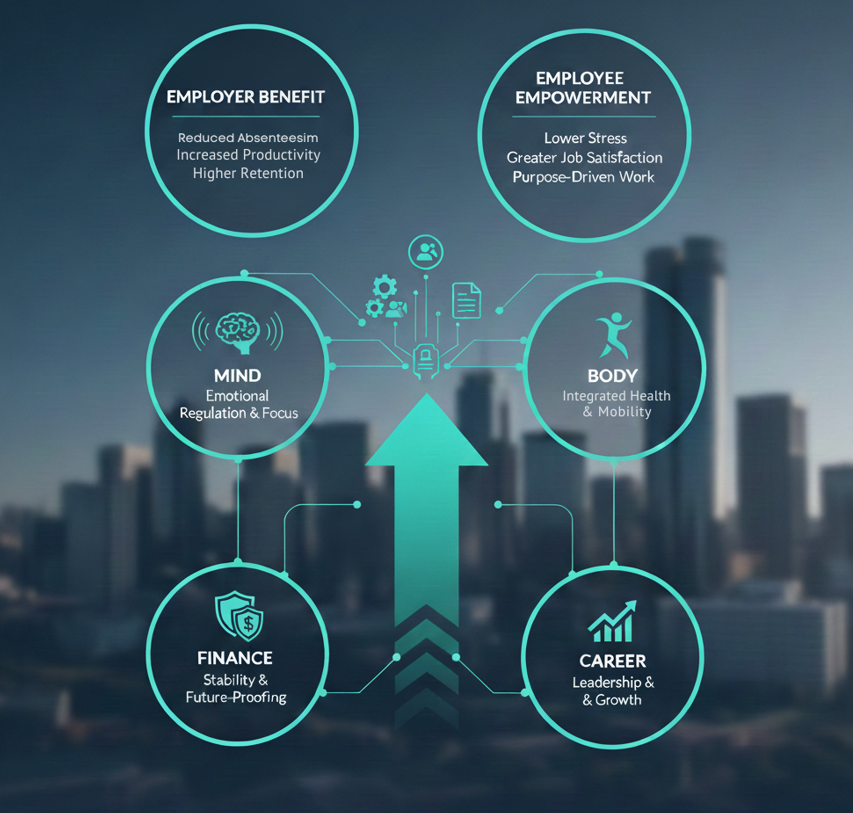
True workplace wellness is not a series of isolated perks or top-down mandates. For a business to thrive, resilience must be a strategic imperative. To bridge the "Engagement Gap," employers must address the four pillars that drive human performance:
Self-empowerment (Mind): Moving teams away from "panic culture" by providing tools for emotional regulation and high-pressure focus.
Physical Foundation (Mobility): Integrating mobility and health into the workday in a way that respects employee autonomy and busy schedules.
Financial Health: Addressing the primary "off-screen" stressor for South Africans to ensure employees can focus on their work rather than financial survival.
Professional Development: Equipping leaders and support staff with the skills to manage teams and expectations by clarity and purpose, rather than by crisis.
The Resilience Ecosystem
The Solvo Perspective: Strength Through Support
At Solvo, our interest lies at the intersection of Human Well-being and Corporate Performance. We believe that a resilient workforce is a company’s most valuable asset and its greatest competitive advantage.
Our mission is to help South African employers rebuild their workforce's resilience by providing an integrated, outsourced infrastructure. By treating the Financial Health, Self-empowerment, Professional development and Mobility as a single, connected ecosystem, we help organizations reduce the administrative burden on HR while fostering a culture where talent doesn't just survive—it excels.
The goal is to transform the workplace from a site of "Performance Chaos" into a hub of Strategic Calm. Because a team that is supported is a team that delivers.
